
Why Do Mice Keep Coming Back? 7 Reasons Chester County Homes Have Recurring Rodent Problems
You thought the mouse problem was finally over.
The scratching in your walls stopped, the traps weren't catching anything, and you hadn't noticed any fresh droppings in weeks.
Then suddenly, you hear scratching again.
Or worse, you spot another mouse running across your garage floor.
Why do mice keep coming back, even after you've already treated your home?
At Budget Exterminating Inc., we've been helping Chester County homeowners with rodent problems since 1997. One of the most common frustrations we encounter is recurring mouse activity.
Here's something important to understand: eliminating the mice currently inside your home and preventing new mice from entering are two different challenges.
Even when a treatment successfully controls an existing rodent population, the conditions that attracted those rodents may still exist.
Let's examine seven common reasons mice return and what homeowners can do to reduce the likelihood of future infestations.
1. Mice Are Still Finding Ways Into Your Home
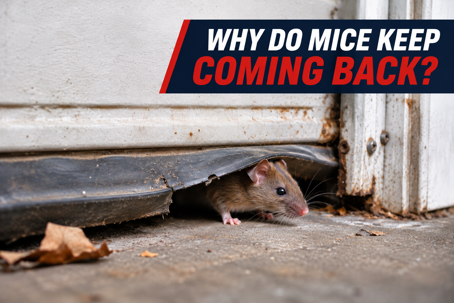
One of the biggest reasons mouse problems return is that exterior entry points remain accessible.
A house mouse can squeeze through an opening approximately 1/4 inch wide.
That's roughly the diameter of a pencil.
Even a well-maintained home may have small openings around:
- Garage-door weatherstripping
- Foundation walls
- Plumbing and electrical penetrations
- Exterior doors
- Crawl-space vents
- Siding transitions
- Areas where different building materials meet
These openings can provide opportunities for mice to enter throughout the year.
A successful rodent treatment doesn't automatically make a home rodent-proof.
If the original entry points remain open, new rodents may eventually find their way inside.
For a more detailed explanation, read our guide, How Are Mice Getting Into My House? 8 Common Entry Points in Chester County Homes.
2. There Are Still Mice Living Inside the Structure
Sometimes, homeowners assume the problem has been resolved because they haven't heard or seen activity for several days.
However, reduced activity doesn't always mean every mouse has been eliminated.
Mice frequently remain concealed in wall voids, attics, insulation, garages, and other protected areas.
Depending on the infestation, some rodents may continue using portions of the home that are difficult to inspect.
This is why monitoring matters.
Fresh droppings, new gnaw marks, repeated sightings, and continued feeding activity can help determine whether rodents are still present.
The absence of a mouse sighting alone isn't enough to confirm that an infestation has ended.
3. Food Sources Around Your Property Are Attracting Rodents
One of the first things we evaluate during a rodent inspection is the availability of food.
Mice are opportunistic feeders and can take advantage of surprisingly small amounts of accessible food.
Common attractants include:
- Bird feeders and spilled bird seed
- Pet food stored in garages
- Chicken feed and livestock feed
- Unsecured garbage
- Food stored in cardboard packaging
- Outdoor feeding areas
- Accessible pantry items
Here in Chester County, we frequently work around properties with sheds, barns, garages, and outdoor storage areas.
These environments can provide rodents with opportunities to find food and shelter.
Even if mice are eliminated from the house, accessible food sources around the property may continue attracting new rodents.
Securing food in durable, rodent-resistant containers and cleaning up spills can help reduce that attraction.
4. Your Garage May Be Providing Easy Access
Garages are one of the first areas homeowners should examine when dealing with recurring mouse activity.
Over time, garage-door seals can deteriorate, become misaligned, or develop gaps.
Mice may take advantage of these openings, particularly when the garage provides shelter and accessible food.
Attached garages can be especially important because they may connect to other portions of the home.
We also frequently find conditions that make garages attractive to rodents, including stored pet food, cardboard boxes, clutter, and infrequently disturbed storage areas.
Addressing garage-door weatherstripping and improving storage practices can be valuable parts of a prevention plan.
5. The Surrounding Environment Supports Rodent Activity
Sometimes, the problem isn't limited to the house itself.
Properties near wooded areas, agricultural fields, overgrown vegetation, and outdoor storage structures may experience ongoing rodent pressure.
This doesn't mean every home near a field or wooded area will have mice.
It means that surrounding conditions can influence how frequently rodents encounter a property.
In Chester County, residential neighborhoods often sit alongside farmland, wooded lots, and other natural environments.
Rodents may move through these areas while searching for food and shelter.
When suitable openings exist, a home can become an attractive destination.
That's why rodent prevention should consider both the structure and its surrounding environment.
6. The Original Treatment Didn't Address the Entire Problem
Mouse traps and rodent bait can be effective control tools when used appropriately.
However, treatment effectiveness depends on factors such as equipment placement, rodent travel patterns, accessible food sources, and the extent of the infestation.
If control equipment is positioned away from active travel routes, rodents may never encounter it.
Likewise, treating one area of a home may not address activity occurring elsewhere.
For example, mice may be active in both the garage and attic, even though the homeowner has only noticed evidence in the basement.
Professional rodent control involves evaluating the activity and developing a strategy appropriate for the property.
It's not simply about how many traps or bait stations are installed. It's about where they're positioned and why.
For more information, read Mouse Exterminator vs. DIY: Why Traps and Bait Alone May Not Solve Your Mouse Problem.
7. There's No Ongoing Monitoring or Prevention Plan
For some homeowners, a one-time rodent treatment may be sufficient to address an isolated problem.
Other properties experience recurring rodent pressure because of structural conditions, nearby food sources, or surrounding environments.
Without continued monitoring, new activity may go unnoticed until rodents have established themselves inside again.
Ongoing rodent management can help identify changes in activity and provide opportunities to address developing problems.
However, monitoring doesn't replace exclusion.
The strongest long-term approach combines appropriate population control, structural exclusion, sanitation, and monitoring when needed.
Does Seeing Another Mouse Mean the Treatment Failed?
Not necessarily.
A mouse sighting after treatment can have several explanations.
There may be remaining rodents from the original infestation, new mice may have entered through accessible openings, or the treatment may require additional time or adjustment.
The timing of the sighting, location of the activity, and other evidence can help determine what is happening.
A professional follow-up inspection can help distinguish between continuing activity and a possible new infestation.
This is one reason homeowners shouldn't evaluate treatment success solely by whether they see a mouse immediately afterward.
How Can You Keep Mice From Coming Back?
While no home can be guaranteed completely mouse-proof, there are practical steps homeowners can take to reduce the likelihood of recurring activity.
Inspect and Repair Exterior Openings
Check garage doors, foundation penetrations, exterior doors, and other accessible areas for potential entry points.
Use appropriate, durable exclusion materials and repair methods.
If rodents are already inside, develop a plan to address existing activity before sealing suspected access points.
Eliminate Accessible Food Sources
Store pet food, bird seed, and other attractants in rodent-resistant containers.
Clean up spilled feed and avoid leaving accessible food in garages or storage areas.
Reduce Potential Shelter
Organize cluttered storage spaces, maintain landscaping, and remove unnecessary debris near the foundation.
Monitor for New Activity
Watch for fresh droppings, gnaw marks, unusual noises, and repeated sightings.
Early identification can help prevent a small problem from becoming more extensive.
Consider Professional Rodent Management
If mice repeatedly return despite your prevention efforts, a professional inspection may help identify overlooked entry points or contributing conditions.
Is One-Time Rodent Control Enough?
That depends on the property and the nature of the infestation.
At Budget Exterminating, our one-time rodent-control service includes an initial treatment and a two-week follow-up appointment.
During the follow-up, we evaluate activity and replenish control materials as needed.
For some homeowners, this approach may be appropriate for addressing an existing problem.
However, properties with recurring rodent pressure may benefit from ongoing monitoring and management.
The important thing is choosing a service based on the property's conditions rather than assuming every rodent problem requires the same solution.
When Does Home Shield Plus Make Sense?
For homeowners who experience recurring rodent activity or prefer ongoing pest protection, Budget Exterminating offers Home Shield Plus.
This program combines general pest control with rodent services.
Rather than waiting until every new problem becomes noticeable, an ongoing maintenance program provides scheduled opportunities to evaluate pest and rodent activity and respond according to the service agreement.
Home Shield Plus may be particularly valuable for homeowners who want a more consistent approach to managing common household pests and rodents.
However, ongoing service isn't a substitute for correcting structural entry points.
For long-term results, treatment and monitoring should work alongside appropriate exclusion and sanitation improvements.
Professional Rodent Control in Chester County, PA
Budget Exterminating Inc. has proudly served Chester County and surrounding Pennsylvania communities since 1997.
As a local, third-generation, family-owned pest-control company, we understand the rodent challenges that homeowners encounter throughout the region.
We provide professional rodent-control services in Downingtown, West Chester, Exton, Coatesville, Malvern, Chester Springs, and surrounding communities.
Whether you're dealing with mice in the basement, recurring activity in the garage, or rodents returning after previous treatment, our team can help evaluate the problem and recommend an appropriate solution.
Tired of Mice Coming Back?
If you've already treated your home but continue finding evidence of mice, there may be underlying conditions that need attention.
Contact Budget Exterminating Inc. today to learn more about our professional rodent-control services and ongoing Home Shield Plus protection.