
What Does a Professional Mouse Exterminator Actually Do? A Chester County Homeowner's Guide
You've discovered mouse droppings in your basement, heard scratching in the walls, or spotted a mouse running across your garage floor.
You know you have a rodent problem, but you're not sure what happens when you call an exterminator.
Do they just put out a few bait stations? How long does treatment take? Will they inspect your home for entry points? And how do you know whether the mice are actually gone?
At Budget Exterminating Inc., we've been helping homeowners throughout Chester County, Pennsylvania, with pest and rodent problems since 1997.
One of the most important things we want homeowners to understand is that professional rodent control involves more than simply placing bait or traps.
A successful treatment starts with understanding the property, identifying where rodents are active, and developing a strategy to control the population.
Here's what homeowners can expect from a professional rodent-control service.
Step 1: Inspecting the Property for Rodent Activity
Before deciding where to place rodent-control equipment, it's important to understand where the activity is occurring.
During an inspection, a technician may examine accessible areas such as:
- Basements and crawl spaces
- Garages and utility rooms
- Accessible storage areas
- Exterior foundation walls
- Areas surrounding plumbing and utility penetrations
- Locations where homeowners have reported droppings or scratching
The goal is to identify evidence of rodent activity and determine which areas need attention.
An inspection may reveal droppings, gnaw marks, nesting material, or frequently traveled routes.
It can also help distinguish mouse activity from rats or other wildlife.
This matters because different pests require different treatment strategies.
Step 2: Identifying How Mice Are Getting Inside
One of the biggest challenges with mouse infestations is identifying potential entry points.
A house mouse can squeeze through an opening approximately 1/4 inch wide.
That means gaps around garage doors, foundation penetrations, utility lines, and exterior doors can provide access.
During a rodent inspection, technicians look for visible openings and structural conditions that may allow rodents to enter.
Some common problem areas include:
- Worn garage-door weatherstripping
- Gaps around plumbing or electrical penetrations
- Foundation openings
- Damaged door sweeps
- Crawl space openings
- Gaps where different building materials meet
Not every opening is immediately visible or accessible, and some properties require additional investigation.
Identifying entry points is an important part of reducing future rodent activity.
For a more detailed breakdown, read our guide: How Are Mice Getting Into My House? 8 Common Entry Points in Chester County Homes.
Step 3: Developing a Rodent-Control Treatment Plan
Once the technician has evaluated the property, the next step is determining the appropriate control strategy.
Not every home requires the same treatment.
A mouse problem confined to a garage may require a different approach than activity throughout a basement, attic, or multiple living areas.
Depending on the conditions and service agreement, professional rodent control may involve strategically positioned bait stations, traps, or other appropriate control methods.
The placement of equipment is important.
Mice commonly travel along walls, behind stored belongings, and through concealed areas rather than crossing large open spaces.
Understanding these travel patterns helps technicians position equipment where rodents are more likely to encounter it.
Rodent-control products must be selected and used according to their labels, with appropriate consideration for children, pets, and non-target animals.
Step 4: Installing and Positioning Rodent Bait Stations
Rodent bait stations are commonly used in professional rodent-management programs.
However, simply placing stations randomly around a property isn't an effective strategy.
Technicians evaluate where rodents are traveling and where control equipment can be positioned appropriately.
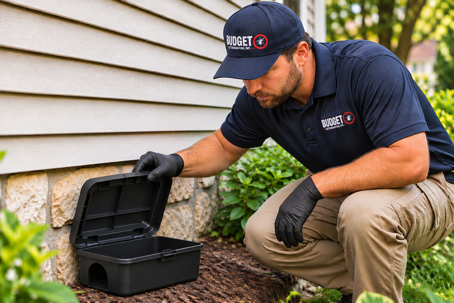
For certain exterior rodent problems, tamper-resistant bait stations may be installed in strategic locations around the property.
Interior control methods depend on the species, activity, accessibility, and applicable product-label requirements.
The goal is to target active rodent areas while minimizing unnecessary exposure to people, pets, and other animals.
Bait stations are a tool in rodent management, not a substitute for a proper inspection or treatment strategy.
Step 5: Monitoring Rodent Activity and Treatment Progress
One question homeowners frequently ask is:
How do you know whether the rodent treatment is working?
Monitoring helps determine whether rodents are interacting with control equipment and whether activity is decreasing.
Depending on the control method, technicians may evaluate bait consumption, trap captures, fresh droppings, or other signs of activity.
It's important to understand that bait consumption alone doesn't necessarily confirm that a rodent population has been eliminated.
A technician should consider the overall evidence and whether new activity continues to appear.
Monitoring also helps determine whether adjustments or additional service may be necessary.
Step 6: Returning for a Two-Week Follow-Up
At Budget Exterminating, our one-time rodent-control service includes an initial treatment and a two-week follow-up appointment.
During this follow-up, we evaluate rodent activity and inspect the control equipment.
We may replenish rodent-control materials as needed and assess whether activity appears to be decreasing.
This appointment provides an opportunity to review the progress of the treatment rather than assuming the problem has been resolved after the initial visit.
If additional service is necessary beyond the included follow-up, our team can discuss the next steps.
We believe follow-up monitoring is an important part of responsible rodent management.
Step 7: Addressing Entry Points and Rodent Prevention
Reducing the current rodent population is only one part of long-term control.
If mice can continue entering through the same structural openings, new activity may develop later.
That's why exclusion and prevention are important.
Depending on the property, recommendations may include:
- Repairing damaged garage-door seals
- Sealing appropriate utility penetrations
- Addressing foundation gaps
- Repairing damaged vents or door sweeps
- Securing accessible pet food and bird seed
- Reducing clutter and potential nesting areas
- Maintaining exterior landscaping around the structure
Some minor openings may be appropriate for targeted sealing, while larger structural repairs or inaccessible areas may require a qualified contractor.
It's also important to evaluate existing rodent activity before closing suspected entry points.
Professional rodent control and proper exclusion work together to reduce the likelihood of recurring infestations.
How Long Does It Take to Get Rid of Mice?
There isn't one universal timeline for every mouse infestation.
The amount of time required depends on several factors, including:
- The size and extent of the rodent population
- Whether rodents are established inside the structure
- The number of accessible food sources
- Whether new rodents can continue entering
- The effectiveness of the selected control methods
- The ability to inspect and monitor affected areas
Some situations may show improvement relatively quickly, while established or recurring infestations can require additional time and service.
That's why it's important to evaluate treatment progress rather than promise that every rodent problem will be eliminated within a specific number of days.
Do Mouse Exterminators Seal Holes Around Your House?
This depends on the pest-control company and the scope of the service agreement.
Rodent exclusion involves identifying and appropriately sealing structural openings that rodents may use to enter a building.
Some openings can be addressed with relatively straightforward repairs, while others require specialized materials, carpentry, masonry, or other professional work.
At Budget Exterminating, we evaluate potential entry points and can discuss appropriate exclusion recommendations based on the property and the services being provided.
Homeowners should always clarify which exclusion work is included in their treatment agreement and which repairs would require additional service.
One-Time Rodent Control vs. Ongoing Rodent Protection
Not every homeowner needs the same service plan.
At Budget Exterminating, we offer options for homeowners dealing with an existing rodent problem as well as those seeking ongoing pest protection.
One-Time Rodent Control
Our one-time rodent-control service is designed for homeowners who need help addressing an existing mouse or rat problem.
The service includes an initial treatment and a two-week follow-up appointment.
During the follow-up, we evaluate activity and replenish control materials as needed.
Additional service, if necessary, can be discussed based on the results.
Home Shield Plus
Our Home Shield Plus program combines ongoing general pest control with rodent services.
This option may be appropriate for homeowners experiencing recurring rodent activity or those who prefer ongoing pest management.
The best choice depends on your property, current rodent activity, and long-term expectations.
Why Hire a Professional Instead of Handling Mice Yourself?
DIY traps and bait can be useful for certain isolated mouse problems.
However, recurring infestations may involve multiple entry points, concealed nesting areas, or conditions that homeowners haven't identified.
Professional rodent management focuses on understanding those contributing factors and developing a structured approach.
For a more detailed comparison, read our article Mouse Exterminator vs. DIY: Why Traps and Bait Alone May Not Solve Your Mouse Problem.
Professional Rodent Control in Chester County, PA
Budget Exterminating Inc. is a local, third-generation, family-owned pest-control company serving Chester County and surrounding Pennsylvania communities since 1997.
We provide professional mouse and rat control throughout Downingtown, West Chester, Exton, Coatesville, Malvern, Chester Springs, and nearby communities.
Whether you're hearing scratching in the walls, finding mouse droppings in the basement, or dealing with recurring rodent activity around your property, our team can help evaluate the situation and recommend an appropriate treatment plan.
Ready to Get Your Rodent Problem Under Control?
You shouldn't have to guess whether the traps you've set are working or whether mice are still entering your home.
Contact Budget Exterminating Inc. today to learn more about our professional rodent-control services and schedule an appointment.