
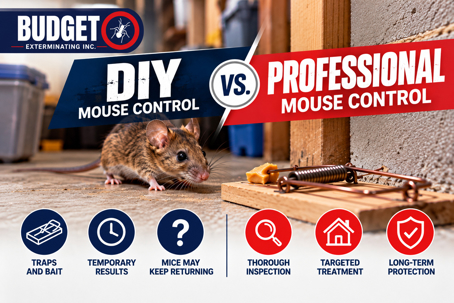
Mouse Exterminator vs. DIY: Why Traps and Bait Alone May Not Solve Your Mouse Problem
You've discovered mouse droppings in your garage, heard scratching in the walls, or even spotted a mouse running across the kitchen floor.
Your first instinct might be to head to the hardware store, purchase a few mouse traps, and hope the problem disappears.
Sometimes, that approach works.
But what happens when you've caught several mice and you're still finding droppings? Or when the scratching stops for a week, only to return?
At Budget Exterminating Inc., we've helped homeowners throughout Chester County, Pennsylvania, address rodent problems since 1997.
One of the biggest misconceptions about mouse control is that eliminating a few individual mice automatically means you've eliminated the problem.
Successful rodent control isn't just about catching mice. It's about understanding why they're there, where they're traveling, and how they're getting inside.
Let's explore when DIY mouse control may be effective, why it sometimes fails, and when professional rodent control makes sense.
Can You Get Rid of Mice Yourself?
Yes. Some minor mouse problems can be resolved with properly placed traps, sanitation improvements, and effective exclusion.
For example, if a single mouse entered through an open garage door and there's no evidence of additional activity, a homeowner may be able to address the situation without professional assistance.
However, the difficulty is determining whether you're dealing with one mouse or an established population.
Mice are naturally cautious, reproduce quickly, and frequently use concealed areas such as wall voids, attics, basements, and garages.
Catching one or two mice doesn't necessarily tell you how many remain.
That's where a more thorough inspection becomes important.
Why Aren't My Mouse Traps Working?
We frequently hear homeowners say they've placed traps throughout their house but continue to notice activity.
There are several possible explanations.
1. Traps Are Placed in the Wrong Locations
Mice commonly travel along walls, behind appliances, and through protected spaces.
Placing traps randomly in the middle of a room may produce disappointing results.
Trap positioning should account for actual rodent movement, evidence of activity, and the surrounding environment.
2. There May Be More Mice Than You Realize
A homeowner might catch two mice and assume the infestation is over.
Unfortunately, additional rodents may still be active in other areas of the structure.
Droppings, nesting material, repeated sightings, and continued sounds can indicate that the problem hasn't been fully resolved.
3. New Mice May Still Be Entering
Even if your traps are successfully removing mice, the problem may continue if exterior entry points remain accessible.
A house mouse can squeeze through an opening approximately 1/4 inch wide.
Gaps around garage doors, utility penetrations, foundations, and exterior doors can provide opportunities for additional mice to enter.
4. Food Sources Are Competing With Your Traps
Accessible pet food, bird seed, pantry items, and other food sources may reduce the effectiveness of certain control methods.
Improving sanitation and securing food can make a meaningful difference in an overall rodent-management program.
5. The Activity May Not Be Coming From Mice
Scratching inside a wall or ceiling doesn't automatically mean mice are responsible.
Rats, squirrels, and other animals can produce similar noises.
Using the wrong control strategy for the species involved can delay a solution.
Why Do Mice Keep Coming Back After Treatment?
This is one of the most frustrating situations homeowners experience.
They purchase traps or bait, see activity decrease, and assume the problem has been resolved.
Then, several weeks or months later, the mice return.
There are several reasons this can happen.
- Unidentified entry points: Small openings around the structure may continue allowing mice inside.
- Existing rodents: Some mice may remain in concealed areas even after activity decreases.
- Accessible food: Bird feeders, pet food, garbage, and improperly stored food can continue attracting rodents.
- Favorable shelter: Garages, crawl spaces, attics, and cluttered storage areas can provide protected environments.
- Lack of monitoring: Without follow-up inspections, it can be difficult to determine whether activity has actually stopped.
- Long-term rodent management often requires a combination of population control, monitoring, sanitation, and structural exclusion.
Should You Seal Mouse Holes Immediately?
Sealing entry points is an important part of preventing future rodent problems.
However, simply sealing the first opening you find may not resolve an existing infestation.
There could be additional entry points, and rodents may already be living inside the structure.
An effective exclusion strategy should account for existing activity and identify the openings that require repair.
Materials and methods matter, too. Mice can gnaw through certain materials, so a durable repair is generally preferable to relying on ordinary expanding foam alone.
For a detailed breakdown of common access points, read our guide How Are Mice Getting Into My House? 8 Common Entry Points in Chester County Homes.
When Should You Call a Professional Mouse Exterminator?
DIY mouse control may be reasonable for an isolated problem, but professional assistance becomes particularly valuable when:
- You've caught multiple mice but continue seeing activity.
- Droppings repeatedly appear in the same areas.
- You hear scratching inside walls or ceilings.
- Mice are active in multiple parts of the home.
- You cannot identify where rodents are entering.
- Previous DIY treatments have provided only temporary relief.
- You suspect rats or another animal may be involved.
- You want a structured monitoring and prevention program.
A professional inspection can help identify contributing conditions and determine an appropriate treatment strategy.
What Does Professional Rodent Control Include?
At Budget Exterminating, we approach rodent problems by evaluating the property and the activity we're dealing with.
Rather than simply placing bait and leaving, we consider where rodents are traveling, where activity is concentrated, and what conditions may be contributing to the infestation.
Depending on the property and service agreement, a treatment plan may involve:
- Inspecting affected areas for rodent evidence
- Evaluating likely travel routes and potential entry points
- Installing appropriate rodent-control equipment
- Monitoring feeding and activity levels
- Replenishing control materials when necessary
- Recommending sanitation or exclusion improvements
- Determining whether additional service is appropriate
Our goal is to develop a practical treatment strategy based on the conditions of the home.
One-Time Mouse Treatment vs. Ongoing Rodent Protection
Not every homeowner needs the same level of service.
That's why Budget Exterminating offers different options depending on the situation.
One-Time Rodent Control
For homeowners dealing with an existing rodent problem, our one-time rodent-control service includes an initial treatment and a two-week follow-up.
During the follow-up, we evaluate rodent activity and replenish control materials as necessary.
If additional services are needed after the included follow-up, our team can discuss the available options.
Home Shield Plus
For homeowners looking for ongoing protection, our Home Shield Plus program combines general pest control with rodent services.
This may be a good option for properties with recurring rodent pressure or homeowners who prefer ongoing pest management rather than waiting for individual problems to develop.
The best option depends on your property, current activity, and long-term goals.
Are Mice Dangerous to Have in Your House?
Mice aren't simply an inconvenience.
Rodents can contaminate food and surfaces with urine and droppings, damage stored belongings, and gnaw on building materials.
They may also damage electrical wiring, which can create a fire hazard.
Rodents can carry disease-causing organisms, although the specific health risks vary by species and exposure.
If you discover rodent droppings, avoid sweeping or vacuuming them while dry. Follow CDC recommendations for safe cleanup, including appropriate disinfection.
For more warning signs, read 7 Signs You Have Mice in Your House: A Chester County Homeowner's Guide.
Why Chester County Homeowners Choose Budget Exterminating
Budget Exterminating Inc. has proudly served Chester County and surrounding Pennsylvania communities since 1997.
As a local, third-generation, family-owned pest control company, we understand the rodent challenges homeowners experience throughout the region.
We provide professional rodent control in Downingtown, West Chester, Exton, Coatesville, Malvern, Chester Springs, and surrounding communities.
Whether you're dealing with mice in the attic, droppings in the basement, or repeated activity in the garage, our team can help evaluate the problem and recommend an appropriate solution.
Tired of Catching Mice Without Solving the Problem?
If you've been setting traps, purchasing bait, and still finding evidence of rodents, it may be time for a more comprehensive approach.
Contact Budget Exterminating Inc. today to learn more about our one-time rodent-control services and ongoing Home Shield Plus protection.