
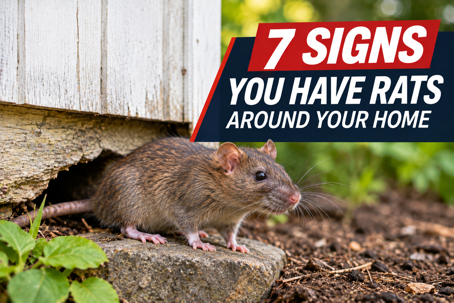
7 Signs You Have Rats Around Your House: A Chester County Homeowner's Guide
You've noticed a strange hole underneath your shed. Maybe your garbage cans have been disturbed overnight, or you've spotted something larger than a mouse running along your fence line.
Could you have rats living around your property?
At Budget Exterminating Inc., we've been helping Chester County homeowners deal with rodent problems since 1997. While mice are commonly found inside homes, rats can create serious problems around exterior structures, gardens, garages, chicken coops, and other areas of a property.
One of the biggest challenges with rat infestations is that homeowners often don't realize how much activity is occurring until the population has become established.
The earlier you identify signs of rats, the easier it may be to address the problem before it becomes more extensive.
Here are seven warning signs every homeowner should know.
1. Rat Burrows Around Your Foundation, Shed, or Garden
One of the most recognizable signs of Norway rat activity is the presence of burrows.
Norway rats are skilled diggers and frequently establish underground nesting areas near structures that provide shelter and access to food.
Common locations include:
- Underneath sheds and decks
- Along building foundations
- Beneath chicken coops
- Around gardens and raised beds
- Underneath concrete slabs
- Near woodpiles and outdoor storage areas
Active rat burrows often have relatively smooth openings, typically a few inches across, with disturbed soil or worn pathways nearby.
However, not every hole in the ground belongs to a rat. Other animals can create similar openings.
A professional inspection can help determine whether a burrow is associated with active rodent activity.
2. Rat Droppings Around Your Property
Rat droppings are another important indicator.
Norway rat droppings are generally larger than mouse droppings, often measuring approximately 1/2 to 3/4 inch long.
They tend to be capsule-shaped with relatively blunt ends.
You may find droppings:
- Inside garages and sheds
- Around stored animal feed
- Beneath outdoor equipment
- Near garbage storage areas
- Along frequently traveled routes
- Inside barns and chicken coops
Fresh droppings may suggest recent activity, although appearance alone cannot reliably determine their exact age.
Important: Avoid sweeping or vacuuming rodent droppings while dry. Follow appropriate rodent-contamination cleanup precautions, including wetting contaminated material with a suitable disinfectant before removal.
If you're finding large quantities of droppings, it's worth having the area inspected.
3. Worn Pathways Along Fences and Foundations
Rats are creatures of habit.
Once they establish a reliable route between their nesting areas, food sources, and shelter, they often travel along the same pathways repeatedly.
Over time, this can create noticeable runways through grass, soil, mulch, or other landscaping materials.
Common travel routes include:
- Along exterior foundation walls
- Beneath fence lines
- Between sheds and gardens
- Around chicken coops
- Behind outdoor storage structures
These routes can be valuable clues when identifying where rats are moving around a property.
Professional rat-control strategies often rely on understanding these travel patterns when determining appropriate control-equipment placement.
4. Greasy Rub Marks Along Frequently Used Routes
Rats have natural oils and dirt on their fur.
When they repeatedly squeeze through narrow openings or travel along the same surfaces, they can leave dark smudges known as rub marks.
These marks may appear around:
- Openings beneath structures
- Narrow gaps along foundations
- Entry points into sheds
- Wall and floor junctions
- Frequently traveled passageways
Rub marks can help identify heavily used rodent routes.
However, dark staining alone doesn't confirm rat activity. It should be evaluated alongside other evidence.
5. Gnaw Marks on Wood, Plastic, or Stored Materials
Rats have continuously growing incisors and regularly gnaw on materials.
Depending on the location, homeowners may discover damage to:
- Wooden structures
- Plastic storage containers
- Garbage cans
- Feed containers
- Exterior building materials
- Accessible wiring or utility components
Rat gnaw marks are generally larger than those produced by house mice.
Damaged wiring can present a fire hazard, so suspected electrical damage should be evaluated by a qualified electrician.
If you're noticing unexplained gnawing around your property, rodents may be responsible.
6. Unusual Activity Around Chicken Coops, Bird Feeders, or Garbage
Food availability is one of the biggest factors influencing where rats establish themselves.
In Chester County, properties with chicken coops, barns, gardens, and outdoor animal-feeding areas can provide attractive conditions for rodents.
Common food sources include:
- Spilled chicken feed
- Livestock feed
- Bird seed
- Unsecured garbage
- Pet food left outside
- Fallen fruit and accessible food waste
Rats are opportunistic feeders.
Even when homeowners maintain clean properties, relatively small amounts of accessible food can support rodent activity.
If you're repeatedly finding disturbed feed containers, damaged packaging, or signs of digging around a chicken coop, it's important to investigate.
Controlling the rat population without addressing accessible food sources can make long-term management more difficult.
7. Seeing Rats During the Day or at Night
Actually seeing a rat is one of the clearest signs that rodents are present.
Norway rats are generally most active during nighttime hours, although daytime activity can occur.
You may spot rats traveling along fences, moving between buildings, or entering burrows.
A daytime sighting doesn't automatically mean an infestation is severe.
Activity patterns can be influenced by food availability, disturbance, competition, and other environmental conditions.
However, repeated sightings—particularly when combined with burrows, droppings, or feeding activity—can indicate an established rodent problem.
Why Are Rats Attracted to Chester County Properties?
Chester County has a combination of residential neighborhoods, agricultural properties, wooded areas, and outdoor structures.
These environments can provide rats with opportunities to find food, water, and shelter.
Common contributing conditions include:
- Chicken coops and animal-feeding areas
- Sheds and barns with accessible openings
- Outdoor garbage storage
- Bird feeders
- Cluttered storage areas
- Vegetation and debris that provide cover
- Accessible water sources
Rats can also move between neighboring properties, so the source of activity may not always be limited to one yard.
This is why a thorough exterior inspection is valuable when evaluating a rat infestation.
Why Rats May Avoid New Bait Stations
One of the most important things homeowners should understand about rat behavior is that rats can be extremely cautious around unfamiliar objects.
This behavior is known as neophobia, or avoidance of new things.
When a new rodent bait station is installed, rats may initially avoid it.
That doesn't necessarily mean the station has been placed incorrectly or that the treatment isn't working.
The time required for rats to investigate a station varies depending on the population, environment, food availability, and placement.
In some situations, rats begin feeding relatively quickly. In others, it may take longer.
This is one reason professional rat management requires patience and monitoring rather than constantly moving equipment after only a few days.
How Does Professional Rat Control Work?
At Budget Exterminating, we evaluate rat activity and determine an appropriate treatment strategy based on the property.
Depending on the situation, this may involve:
- Inspecting the property to identify burrows, droppings, travel routes, and other evidence of activity.
- Evaluating potential food sources and shelter that may be contributing to the infestation.
- Strategically positioning rodent-control equipment in appropriate locations.
- Monitoring activity to determine whether rats are interacting with the equipment.
- Completing follow-up service to evaluate progress and determine whether additional treatment is necessary.
For one-time rodent-control services, Budget Exterminating includes an initial treatment and a two-week follow-up.
At that follow-up, we assess rodent activity and replenish control materials as needed.
Some rat infestations require additional treatments, particularly when activity is extensive or environmental conditions continue supporting the population.
Want to learn more about the inspection and treatment process? Read our guide, What Does a Professional Mouse Exterminator Actually Do?, to see what goes into professional rodent management.
How Long Does It Take to Get Rid of Rats?
There's no single timeline that applies to every rat infestation.
The length of treatment depends on the size of the population, available food sources, nesting locations, and how quickly rodents begin interacting with the control equipment.
Because rats may initially avoid unfamiliar bait stations, it's important to allow sufficient time for monitoring and treatment adjustments.
An established infestation may require multiple visits.
Homeowners should also understand that reducing accessible food sources and addressing potential harborage areas can improve the effectiveness of a broader rat-management program.
Are Rats Dangerous Around Your Home?
Rats can contaminate surfaces and stored materials with urine and droppings, damage structures, and create sanitation concerns.
They may also carry pathogens or parasites that pose health risks.
Homeowners should avoid directly handling rats, disturbing suspected nesting areas without precautions, or attempting unsafe cleanup of contaminated materials.
If you suspect a significant infestation, professional assistance can help determine the appropriate next steps.
Professional Rat Control in Chester County, PA
Budget Exterminating Inc. is a third-generation, family-owned pest-control company proudly serving Chester County and surrounding Pennsylvania communities since 1997.
We help homeowners address rat activity around houses, garages, sheds, gardens, chicken coops, and other exterior structures.
Our service area includes Downingtown, West Chester, Coatesville, Malvern, Honey Brook, Parkesburg, and surrounding communities.
Whether you've discovered suspicious burrows, noticed rats around your chicken coop, or are dealing with ongoing exterior rodent activity, our team can help evaluate the problem and develop an appropriate treatment plan.
Seeing Signs of Rats Around Your Property?
Don't wait until rodent activity becomes more extensive.
Contact Budget Exterminating Inc. today to schedule professional rat-control service and learn how we can help get your rodent problem under control.