
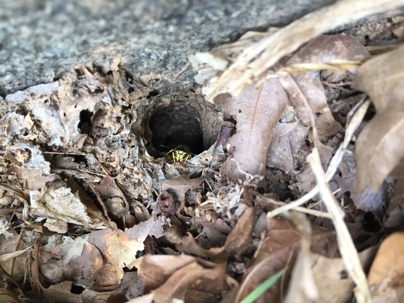
Underground Yellow Jacket Nests: What Every Homeowner Should Know
You're mowing the lawn when, all of a sudden, several yellow jackets begin flying up from the ground around your feet.
Within seconds, you realize you're standing next to an underground yellow jacket nest.
Unfortunately, this is one of the most common calls we receive every summer at Budget Exterminating. In fact, during the 2025 season alone, we treated more than 300 yellow jacket nests throughout Chester County and the surrounding communities.
Most homeowners don't realize a nest is there until they've already disturbed it.
If you've noticed yellow jackets flying in and out of the ground, this guide will help you understand what you're seeing, why these nests are so dangerous, and why professional treatment is often the safest solution.
Quick Answer
An underground yellow jacket nest is a colony of aggressive social wasps that typically develops inside abandoned rodent burrows, underground voids, or wall cavities. Colonies grow throughout the summer and can contain thousands of workers by late August. Because the nest entrance is often only a small hole in the ground, homeowners frequently don't notice it until it's accidentally disturbed.
What Is an Underground Yellow Jacket Nest?
Unlike paper wasps that build exposed umbrella-shaped nests or bald-faced hornets that construct large aerial nests, yellow jackets often build their colonies underground.
Rather than digging their own tunnels, they usually take over existing cavities such as:
- Abandoned mouse burrows
- Chipmunk tunnels
- Vole holes
- Natural voids beneath landscaping
- Cavities beneath retaining walls
- Wall voids inside homes
From the surface, all you may see is a small entrance hole with yellow jackets constantly entering and leaving.
Beneath the surface, however, the colony can be surprisingly large.
From the Field: More Than 300 Yellow Jacket Nests in One Season
At Budget Exterminating, yellow jackets are one of our busiest seasonal services.
During 2025 alone, we treated over 300 yellow jacket nests, with the busiest period beginning in late July and continuing through early October.
One thing we've learned after treating hundreds of these nests is that homeowners almost always underestimate the size of the colony.
Many people tell us:
"I only see five or six flying around."
What they don't realize is those few workers are just a tiny fraction of the colony. In some cases, there may be thousands of yellow jackets hidden underground or inside a wall void.
One of the largest nests we've ever treated contained an estimated 10,000 or more workers.
How Do You Know If You Have an Underground Yellow Jacket Nest?
The biggest clue isn't the hole.
It's the traffic.
Watch from a safe distance.
If multiple yellow jackets repeatedly disappear into the exact same spot in the ground and then reappear a few seconds later, you've likely found the nest entrance.
Other warning signs include:
- Constant activity in one location
- Yellow jackets flying low over your lawn
- Increased activity while mowing
- Buzzing near landscaping
- Pets showing unusual interest in one area
Where We Commonly Find Underground Nests
Throughout Chester County, we regularly find nests:
- In lawns
- Along retaining walls
- In mulch beds
- Around landscape timbers
- Near patios
- Under decks
- Beside sheds
- Around tree roots
- Along wooded property lines
- Inside wall voids
Some properties seem to attract yellow jackets year after year, while others may never experience a problem.
Why Underground Yellow Jacket Nests Are So Dangerous
Hidden nests are dangerous because they're easy to disturb accidentally.
Common situations include:
- Mowing the lawn
- Pulling weeds
- Mulching flower beds
- Children playing in the yard
- Dogs investigating the entrance
- Moving firewood or landscaping materials
When the colony senses vibrations or movement near the entrance, worker yellow jackets release an alarm pheromone.
Within seconds, dozens—or even hundreds—of workers may emerge to defend the nest.
Unlike honey bees, yellow jackets can sting repeatedly.
Common DIY Mistakes We See
Every year, we respond to calls after homeowners have tried to solve the problem themselves.
The most common mistakes include:
❌ Sealing the entrance hole
❌ Using store-bought aerosol sprays
❌ Pouring gasoline into the nest
❌ Flooding the hole with water
❌ Digging up the colony
The biggest mistake is sealing the entrance before the colony has been eliminated. Doing so can force yellow jackets to create a new exit, sometimes inside the structure itself.
Technician Tip
One thing we always tell homeowners is this:
If you find yellow jackets flying into the ground, don't investigate up close.
Instead, step back and observe from a safe distance.
The more you disturb the area, the more likely the colony is to become defensive.
What to Expect After Professional Treatment
This surprises many homeowners.
After treatment, you may actually notice more yellow jacket activity around the entrance for a short time.
That's completely normal.
As affected workers release distress pheromones, foraging yellow jackets return to the nest. For a brief period, it may look like the problem is getting worse.
In most cases, colonies are fully eliminated within 24 to 72 hours, depending on their size and location.
Myth vs. Fact
Myth:
"If I seal the hole, the yellow jackets will die."
Fact:
Sealing the entrance can force yellow jackets to chew their way into other parts of the property, including wall voids and living spaces.
Myth:
"A can of wasp spray will eliminate the entire colony."
Fact:
Most over-the-counter aerosols only affect the insects near the entrance and rarely reach the heart of an underground colony.
Frequently Asked Questions
How many yellow jackets live in an underground nest?
Large colonies can contain several thousand workers by late summer. Some of the largest colonies we've encountered are estimated to have exceeded 10,000 workers.
When are underground yellow jackets most active?
The busiest season is typically late July through early October, when colonies are at their largest and most defensive.
Will dogs find underground nests?
Sometimes. Dogs may sniff around an entrance and accidentally disturb a colony, but they're not always the first to discover a nest.
Should I block the entrance?
No. Leave the entrance alone and contact a professional for proper identification and treatment.
Can underground yellow jackets damage my home?
If the colony is inside a wall void and the entrance is blocked, workers may chew through drywall or other materials while searching for another exit.
Professional Underground Yellow Jacket Removal in Chester County
Underground yellow jacket nests are one of the most common—and most dangerous—stinging insect problems we encounter throughout Downingtown, West Chester, Coatesville, Malvern, Exton, Chester Springs, and the surrounding Chester County communities.
As a third-generation family business, Budget Exterminating has spent decades helping homeowners safely eliminate yellow jacket colonies and reclaim their yards.
If you've noticed yellow jackets flying in and out of the ground or suspect a hidden nest on your property, don't take unnecessary risks. Contact Budget Exterminating for a professional inspection and safe, effective treatment.